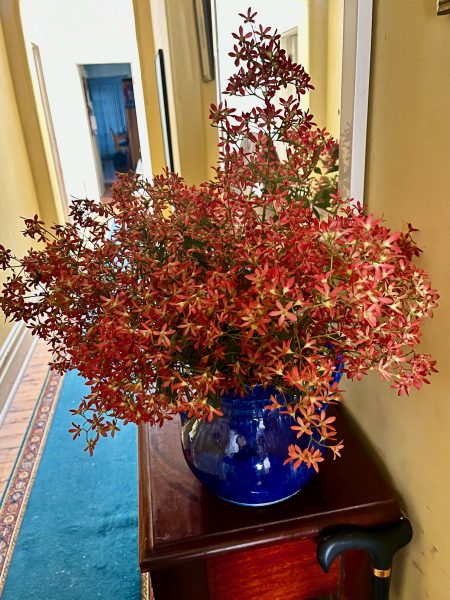
There is a blue jardiniere that I brought home from my late mother’s house this week. For the majority io my childhood it sat on a side table as you entered our house. It usually held the detritus of daily living – matchbooks, golf tees, elastic bands and odd buttons, yet in December the jardiniere would always go through a Christmas miracle – it regained its purpose to hold flowers for the season. I want to regain my purpose to hold flowers too, but I’ll get onto that shortly.
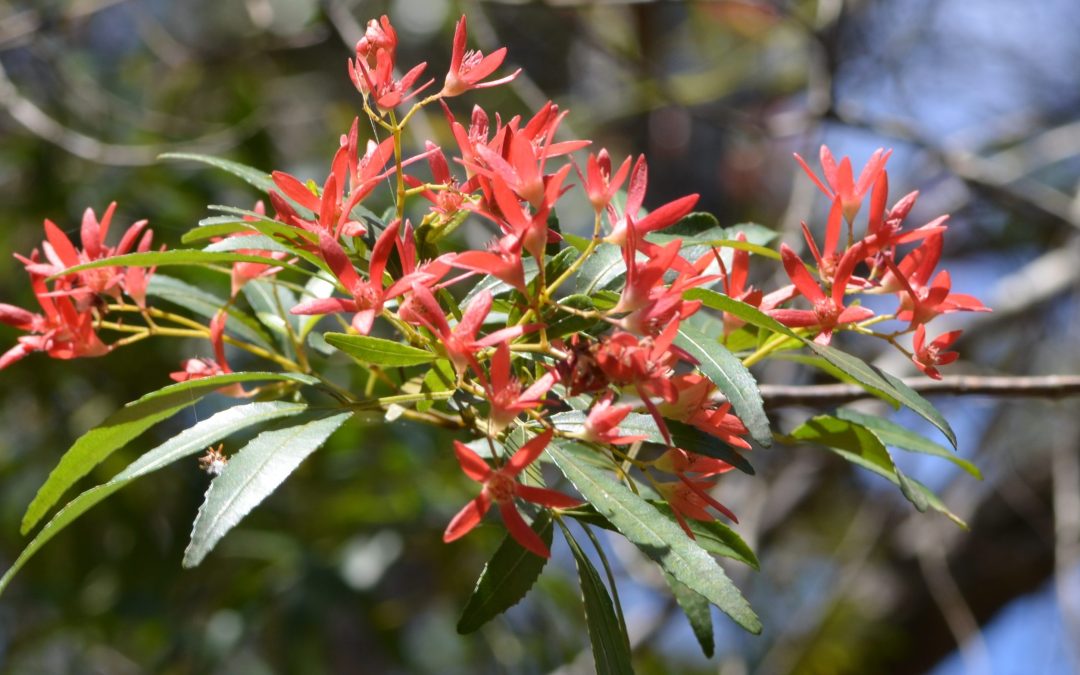
Christmas in Australia is a topsy turvy time. Santa can be depicted in full fur trimmed regalia but with swimming trunks. Rather than a sleigh you might encounter him arriving on a surfboard at Bondi Beach. Northern hemisphere food traditions of turkey and ham are transformed in seafood buffets and endless chardonnay. Where those in the North snuggle in ugly jumpers and roll their eyes ironically at Mariah Carey while singing along, we spread out on the beach in next to nothing and turn blisteringly red like Rudolph’s nose. Our backyards are alive with cicadas, sizzling barbecues and the glow of Christmas Bush. And it is this salmon red flower, all tightly bunched on spiky leaves, that my mother coveted and placed in the blue jardiniere.
She, unlike me, loved Christmas. The placing of this native plant in the blue vase was a ritual that marked the start of the festive season. If drought meant that the bush did not flower, we were (according to her prognostications) ‘in for a miserable Christmas and a harsh new year’. But if it was lush and a bright, health and wellbeing would flow. These predictions only mattered when the Christmas bush was placed in the jardiniere and not before. The future was decided with an offering of flowers.
Buddhist rituals also begin with flowers, either real, spoken of, or symbolically represented. A shrine may be adorned with blooms, or a lotus podium on which the Buddha image rests. We may make our hands into the Anjali mudra, symbolic of a flower offering.
The Sevenfold Puja, a core devotional text of the Triratna Buddhist Community, evokes flowers from the outset. Flowers are offerings, a commencement rite, a welcoming ritual, a gift of gratitude and appreciation.
‘With mandarava, blue lotus and jasmine,With all flowers pleasing and fragrant,And with garlands skilfully woven,I make honour to the Princes of the SagesSo worthy of veneration.”
Floral offerings in this text begin with the mandarava flower, a mythical plant that is said to only grow in the heavens. However, this is only one kind; the other variety of mandarava is the coral tree, known for its bright red flowers that rise up like fingers, almost like those we might clasp together in veneration. I grew up with these gnarled thorny trees at the end of my street – a remnant of a Chinese market gardener who had brought a piece of home with him. I came alive in that wild place down the road, particularly in the height of summer when it was cool under the canopy and the red flowers reached for the sky.
Technically the blue lotus is also a mystical bloom, but it’s more earthly cousin, the blue lily, is very real indeed and prized for its medicinal properties. It has inspired art, design and architecture in the ancient world and been an integral part of spiritual practices for millennia. Jasmine, however, is now a common garden flower, white and delicate though strongly perfumed. You smell it often before you even see it.
And so here we have flowers both real and legendary. Flowers that are red, blue and white are offered to the Buddhas and all those who seek Enlightenment. It may be a coincidence that these three colours are highlighted here, but I prefer to think not. These three colours call to mind the seed syllables of, in turn, speech, mind and body. We begin with reciting the words, then our mind is engaged with the symbols and lastly we might ground ourselves in the experience of making physical offerings to the shrine.
In reciting these words we offer that which we can only imagine, that which can rarely see and that which me might have in the bottom of the garden at certain times of the year. These are living things of delicate beauty that arise in only the most perfect conditions. But think of this for a moment: we too are living things of delicate beauty that arise in only the most perfect conditions. Yes, even we are beautiful. And here, in this practise, in this moment of devotion, as we brings our hands together, we offer the flower of ourselves. We transform ourselves through devotion, through aspiration, through wanting to turn to the light of awakening as flowers grow towards the sun.
Our actions, be they elevated and ‘heavenly’ or rare like a lotus, or relatively commonplace like jasmine, are the true flower offerings. What we say, think and do are what truly matters. We can even weave such actions into practices, here alluded to as the ‘garlands skilfully woven’ like the ones placed around the necks of visitors to Indian homes.
Visitors to our home, back in the 1970s, would be likewise welcomed by this jardiniere bursting with colour. Many would stop and react at the colour or the size of the bouquet. It had a real impact because, unlike the battery powered dancing Santa Claus singing ‘Deck the Halls’, it was a real offering to what the season was really about – a time for sharing and connection based around a cherished story.
I want to be as real as that blue glazed vase brimming with flowers. I want to see myself and others as beautiful. I want to turn to the light, particularly when all is dark both within and without. And through ritual, I make these wishes, this future, a reality.